
Rev. Father Francis Xavier Philip
 |
He was Rev. Father Francis Xavier Philip, the first Tamil secular priest of Ceylon. Born in Jaffna. he became a priest of God at Bolawatte, during lent 1857. After his ordination, he was at Bolawatte for a few months. Later, in 1857. he went to Kurunegala and worked there till 1869. Then he came to Batticaloa, with a commission to start a boys' English school. He was asked to do this with a sum of Rs. 500/- which was quite a sum of money in those days. Fr. Francis Xavier. besides being a holy and zealous priest of God. was "a man of great energy and drive". So, he ended up by establishing not one but three schools: St. Michael's English School, St. Mary's Boys Vernacular School and St. Cecilia's Girls' English School.
Many do not know that it was he, who laid the foundation of the new St. Mary's Church. as it stands today. No wonder Fr. Charles Richard S. J. calls him "a man of great activity and enterprise" in his Historical sketch of the Mission of Trincomalee
We have often heard Fr. P. N. Peiris S. J. using the phrase "doing well" in his pep talks about St. Michael's College. St. Michael's is doing well" was his famous slogan. May be, if he knew that he was only quoting a famous predecessor. he would feel gratified. Fr. Francis Xavier, writing to Bishop Mgr Bonjean in 1874 says. I am glad to be able to say that my two schools are doing well. I have 57 pupils in the English school with three teachers and 127 students in the Tamil school" Today St. Michael's College has a total no of 1137 students and 55 teachers. The Primary school has 262 students with 11 teachers. History has been unkind to us, in the sense, it has left no details nor a photograph of our founder. We know very little about him. a boat older people still speak of to which he had fitted paddle wheels. which allowed him to travel rapidly over the lake, at a time when coastal roads or the bridge did not exist. He had also built piece by piece, a large clock with weights and placed it in a tower near the church. Still another anecdote bears witness to his eloquence and popularity. While doing his pastoral rounds, he had once mislaid his umbrella He searched for it in all possible places and could not find it. The following Sunday, the church vibrated; ........give unto Caesar, what is Caesar's and give Fr. Francis Xavier. what is his......" and so on. The next day, the umbrella was found on the doorstep of the parish house.
After he left Batticaloa. he served the people of Chilaw for a short period. He returned to Bolawatte and went to his eternal reward on 17-4-1886.
Rev. Fr. Ferdinand Bonnel (Architect of SMC)
 |
Anyone who ventures to make a survey of the progress of Education in Batticaloa will be pleasantly surprised to discover the fact that Batticaloa was not far behind the other parts of Sri Lanka in having had its own quota of very talented and eminent educationists. Loo ming very large on the educational horizon of Batticaloa are such great personalities as Miss. G. Croft of Vincent Girls' High School, Srimath Swami Vipulananda of Shivananda Vidyalaya, Rev. Fr. F. Bonnel of St. Michael's College, Rev. Selby of Methodist Central College and Rev. Mother Lucy of St. Cecilia's Girls' School. What a formidable galaxy of eminent educationists for such a small benighted old town as Batticaloa with a hoary past that dates as far back as the glorious days of the Kandyan Kingdom of which it was a part! Among these educationists Rev. Fr. Bonnel has perhaps left an indelible impress on the longest period of Batticaloa's Educational History. Many a young man who came under his magnetic and mellowing influence would have felt the impact of his most lovable, none the less, stern personality. When he stood erect- and he always stood, sat and lay himself down erect he was lean and tall like a carven marble statue that had sprung into life under the skilful hand of a master sculptor. There was compassion and serenity in those pair of bluish grey eyes with a penetrating look. The look was intense, and the gaze seemed to run through your entire mortal frame. You felt puny as if you had suddenly come into contact with an overwhelming presence. He spoke very little. It was his gaze that controlled and disciplined every one of the young minds that were fortunate enough to come under his influence. When Father Bonnel just walked along the long corridors of the College there was perfect silence and orderliness. Everyone, both the members of the tutorial staff and the students knew and felt his silent presence.
On the last Friday of the month when the entire school assembled in the College Hall for the presentation of the insignia of merit and honour to the deserving students, there used to be the usual hum of little voices that rose and fell with the arrival of the class masters. Last of all when Fr. Bonnel made his appearance on the corridor, the hum and laughter and the prattle of little voices died down into a dead silence. One felt as if one wore enshrouded in eternity where time and tide, colour and form had mingled into nothingness. The silence told: and everyone, both staff and pupils drank deep of it. Then the dominating personality in the person of Rev. Fr. Bonnel walked like a colossus and entered the hail. It was an experience: unforgettable, Unforgotten. What a marvel! What stern discipline! What a mighty impact of a loving guru on his loving disciples!
On an occasion such as this, one felt and apprehended that there was a notion called discipline. It was not just a spoken word. It was not even an idea. It was a real living experience. Its full significance, and its exact meaning coursed through one's veins; and the hearts of both the guru and disciple beat in consonance and felt and realised that the purpose and aim for which they had come together was something laudable something noble. Can there be a greater lesson than this? At. St. Michael's a clock ticked, and our movements were punctuated by the tick of this clock; and what do you think, this master clock was? It taught us the essential value of Kals time It was no other than Fr. Bonnel. His movements were so exact that one could have depended upon them for setting one's timepiece. Whether he entered the classrooms, went into the Laboratory. visited His Lordship the Bishop, wended his way to the Post office to post letters, knelt at the feet of the Master in the College Chapel every action of his was performed with clock regularity.
As a teacher of subjects Fr. Bonnel was full of bubbling enthusiasm and loving kindness. He loved and recognised every one of his pupils and took great care and pains to prepare his lessons with meticulous attention, He had volumes of past question papers of the Cambridge Senior Examination in Mathematics, Chemistry, Physics. Botany and Geography for which he had solutions worked out and neatly bound in book form. Geography was his pet subject and Chemistry and Physics, Botany and Mathematics occupied no less a place in his scheme of things. He laboured hard to build up and maintain the fin Science Laboratory and Geography Room in Batticaloa in a very attractive and orderly manner. On an evening, he often entertained his pupils with pictures of lovely scenery of geographic interest mounted on his stereoscope or with cinematograph film strips. Pathe-Baby was a regular feature, and a favourite among the children. Among his re collection of books on travel and geographical topics were 'Mackinder's "Brita and British Seas', 'Seven Heden' Himalayan Travels', 'Lyell's Principle of Geology and the entire set of Herbertson's Regional Geographies At a time when the imparting of Scientific knowledge and the reception of I was considered the peculiar privilege of the few, and very scant attention paid to the teaching of science, Fr. Bonnel was the first pioneer to give prominence to this theme. Many an eminent pupil of his got the flair for the study of the rare sciences like Chemistry and Physics and Botany from his encyclopaedic knowledge and untiring interest in these subjects. He presented his lessons with such keen interest and zest that his pupils felt the very marvels in nature. and were overwhelmed and awed by their novelty. His aim appeared to be not the mere imparting of knowledge. He aspired to inspire his pupils; and many a pupil of his, will bear ample testimony to this masterful influence of the master mind. A lesson, from Fr. Bonnel's point of view, was a single, undivided, integrated whole. It was an experience. It had to be lived through, felt and made part and parcel of one's own being, so that it may not be said to stand out as a separate entity.
Rev. Fr. Bonnel belonged to a gene- ration of religious which appears to be fast vanishing. He came in the tradition of inspired and devoted torch - bearers. Their intention was not merely to hand over the torch of learning from one generation to the next. Their purpose was a divine one, inspired by a no less divine call: to set aflame the spark that was already in one's pupil. They performed their task, in the right spirit with the utmost sincerity, stark earnest- ness and unrelenting seriousness of purpose. It was their mission in life. Austerity was the hallmark of Fr. Bonnel's entire career. A bare plank served as his bed and a brick or two propped up his head and served as his pillow. Prom early morning till late in the evening: till the hour he had his head on his hard pillow and stretched his limbs on the bare plank, it was a day every minute which he was aware of and each minute he endeavoured to put to the best use. He may be said to have accounted for every second of his life. He never did stand and wait, he worked and laboured.
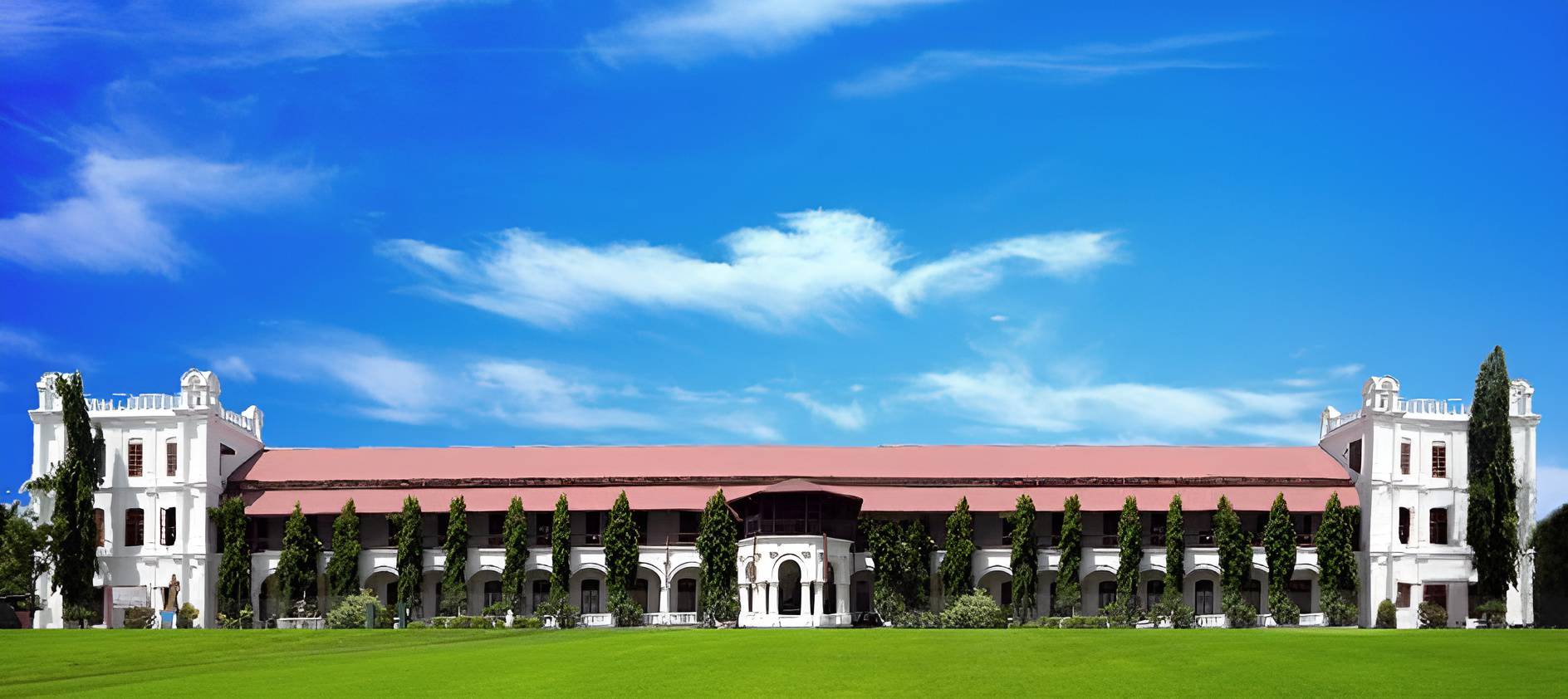
So long as Fr. Bonnet was, at the helm of affairs at St. Michael's, not a lady was employed on the staff and not a female form could enter its portals without his sanction. No females were permitted to perform on the College stage. He was a walking university. To watch him walking across the College lawn was in itself a lesson in self-discipline. Sri Lanka cannot boast of many educationists of Fr. Bonnel's type, of his intellectual calibre and moral rectitude. Our humble and earnest prayer and sincere wish is that Sri Lanka may be fortunate enough to get the services of such selfless men as Rev. Fr. Bonnel. Then this emerald Isle, this pearl adorning the bosom of Mother India will be free of all the ailments that it appears destined to have been heir to. Stilled is that voice, and the light has gone out of those eyes; but the indomitable spirit still lives and guides and permeates the Alma Mater. What was said of Brutus may still be said of Rev. Fr. Ferdinand Bonnel: This was a man: when will come such another?"